Centralized Food Court POS System: How Single-Card Billing Maximizes Footfall Spend and Eliminates Theft
September 17, 2026 in Blog
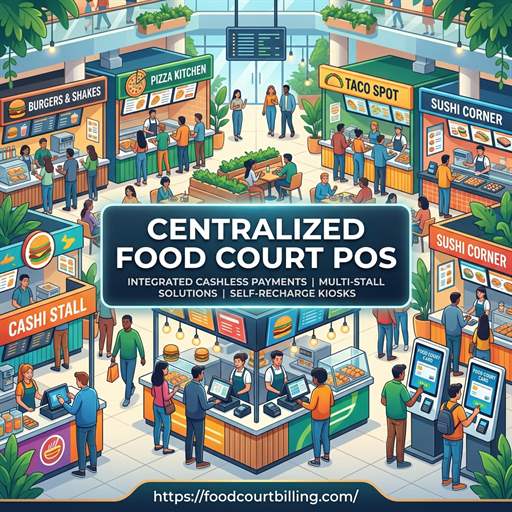
Shopping mall food courts and commercial multi-brand dining halls generate immense revenue through high footfall. However, traditional decentralized payment setups—where every food stall manages its own cash drawer and credit card POS—create massive operational blind spots. Property owners face revenue under-reporting, cashiers pocket cash payments, and diners face frustrating queues as they fumble for small change at every stall. Transitioning to a centralized food court billing system powered by a single closed-loop prepaid smart card eliminates theft, automates tenant reconciliations, and unlocks substantial spend growth.
The Problem with Decentralized Food Court Cash Registers
When each food court vendor accepts cash independently, the landlord or food court master concessionaire loses complete visibility over gross sales. Common points of revenue leakage include:
- Cashier Skimming: Counter staff hand over food without generating a bill or pocket cash payments directly.
- Unreported Sales for Revenue-Share Tenants: Under-reporting daily gross sales lowers the percentage commission owed to the mall management.
- Slow Counter Velocity: Handling paper currency, calculating change, and waiting for mobile QR network confirmations wastes 30 to 45 seconds per diner during peak lunch and dinner surges.
How Centralized Single-Card Billing Works
A centralized food court POS model restructures the payment flow into an intuitive, secure two-step customer journey:
- Central Recharge Counter / Self-Service Kiosks: Diners purchase a reusable food court smart card or reload their existing card using cash, UPI QR codes, or credit cards upon entering the food court.
- Frictionless Tap-and-Order at Stalls: Customers browse food counters, select dishes, and tap their smart card against the stall POS reader. The transaction validates locally in under 0.5 seconds, immediately dispatching a Kitchen Order Ticket (KOT) to the food preparation line.
Why Single-Card Billing Maximizes Customer Footfall Spend
Behavioral economics shows that preloading money onto a branded smart card removes the psychological pain of paying with physical cash. When visitors load \$50 or ₹1,000 onto a card, they perceive the balance as dining credits already spent. Consequently, diners are far more likely to order impulse appetizers, gourmet drinks, and desserts from secondary stalls. Case studies across commercial food courts indicate a 15% to 22% increase in average ticket size following the implementation of closed-loop smart cards.
Automated Tenant Settlements & Transparent Commission Splits
Food court lease contracts frequently involve revenue-sharing agreements where the property owner takes a percentage of daily gross sales alongside a base rental fee. Manually auditing paper receipts from dozens of vendors at the end of each day or month is slow and error-prone. A multi-vendor food court POS automatically calculates tenant commissions in real time. The software generates daily settlement reports detailing total items sold, gross revenue per vendor, management commission deductions, and net payout amounts. This transparency builds trust between landlords and food court tenants.
Offline Local Server: Zero Downtime in Busy Malls
Mall basements and indoor food courts often suffer from poor cellular reception and clogged public Wi-Fi. A cloud-only POS system will stall during network drops, bringing checkout lines to a standstill. An offline-first local server database ensures all card balance reads, transactions, and KOT printings execute locally in under a second with 100% uptime, automatically syncing financial data to the cloud in the background when connectivity resumes.
Deploy Centralized Food Court Billing
Advance Technology Systems (ATS) provides turnkey centralized food court POS systems, smart cards, multi-vendor settlement engines, and offline-first local servers.
Conclusion
Adopting a centralized food court POS system transforms multi-vendor management. By eliminating physical cash from concession counters, mall operators protect their revenues against theft, speed up dining queues, ensure effortless vendor settlements, and boost overall food court profitability.
FAQs: Centralized Food Court POS Systems
- Q1: What is a centralized food court POS system?
- A: A centralized food court POS system is a unified billing platform where visitors use a single prepaid smart card or digital token across all independent food counters in a mall or commercial food court, eliminating cash handling at individual stalls.
- Q2: How does single-card billing eliminate cashier theft in food courts?
- A: Because individual food stalls do not operate cash drawers, food stall workers cannot pocket cash, offer unbilled meals, or manipulate bills. Every meal order requires a verified card deduction before preparation.
- Q3: Why do customers spend more money with a food court card?
- A: Preloading funds onto a food court card reduces physical cash pain points. Customers order appetizers, beverages, and desserts impulsively across multiple stalls without counting change, increasing average spend by up to 20%.
- Q4: How does the system handle tenant sales settlements?
- A: The centralized database records every transaction tagged to specific stall IDs. At day's end, the software generates automated audit reports showing gross sales, agreed commission deductions, and net vendor payouts.
- Q5: Can customers top up their cards using UPI and credit cards?
- A: Yes. Central recharge desks and self-service top-up kiosks accept cash, UPI QR codes, debit cards, and credit cards.
- Q6: What happens if a customer does not spend the entire card balance?
- A: Customers can redeem unspent funds instantly at central cash refund desks before exiting the mall, or keep the balance for their next visit.
- Q7: Does the system support Kitchen Order Ticket (KOT) printing?
- A: Yes. As soon as a customer's card is tapped at a counter, thermal KOT printers or Kitchen Display Systems (KDS) inside the respective kitchen receive the exact order details immediately.
- Q8: Does the centralized POS system operate during internet disruptions?
- A: Yes. The system utilizes an on-premise local server network, allowing POS terminals, card readers, and printers to execute checkouts in less than a second even if the internet goes completely down.
Centralized Food Court POS Solutions
Upgrade your commercial food court with our prepaid card software and experience complete operational control.