Offline-First Canteen Billing Software: Why Local Server POS Outperforms Cloud Systems in Peak Hours
September 17, 2026 in Blog
Software-as-a-Service (SaaS) and pure cloud billing applications dominate the retail landscape. However, institutional dining environments—such as school cafeterias, factory canteens, corporate dining hubs, and busy food courts—operate under fundamentally different conditions. Diners arrive in huge waves during tightly constrained 15 to 30-minute meal breaks. When hundreds of transactions hit the registers simultaneously, reliance on remote cloud servers leads to network timeouts, spinning loading wheels, and frozen checkout queues. Deploying an offline-first canteen billing software backed by an on-premise local server network guarantees sub-second transactions with zero internet downtime.
The Cloud POS Dilemma in High-Density Canteens
Cloud-only POS systems execute every action over the public internet. Every item selection, smart card balance query, and order dispatch must ping a remote cloud server. In high-traffic dining halls, this architecture creates severe vulnerabilities:
- Network Congestion & Latency: During lunchtime, hundreds of diners and staff connect to campus Wi-Fi or cellular networks simultaneously, drastically degrading bandwidth.
- Complete Operational Stoppage: If a local fiber cable is cut or the ISP experiences service degradation, cloud cash registers freeze completely, preventing students or employees from purchasing food.
- Checkout Bottlenecks: Waiting 5 to 10 seconds for remote cloud payment confirmations turns a 5-minute lunch line into a 25-minute bottleneck.
How Offline-First Local Server Architecture Operates
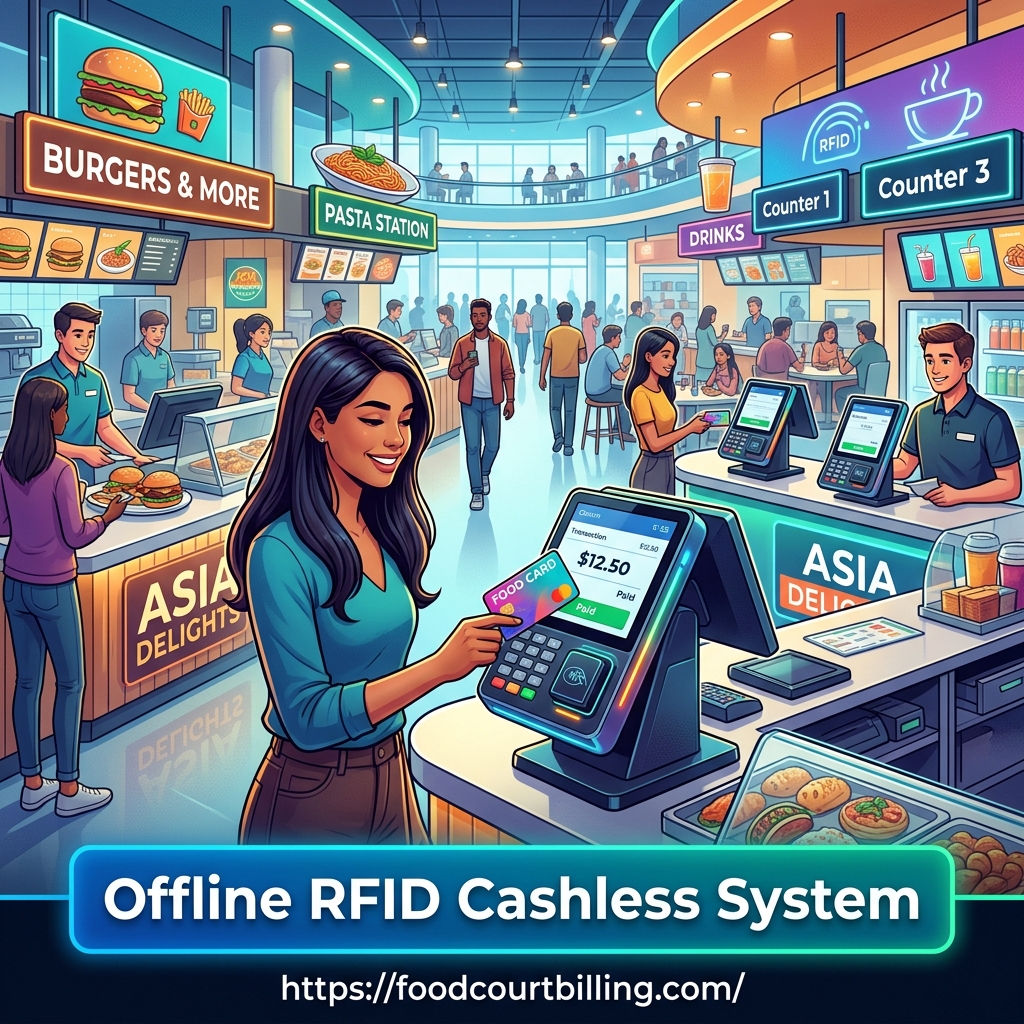
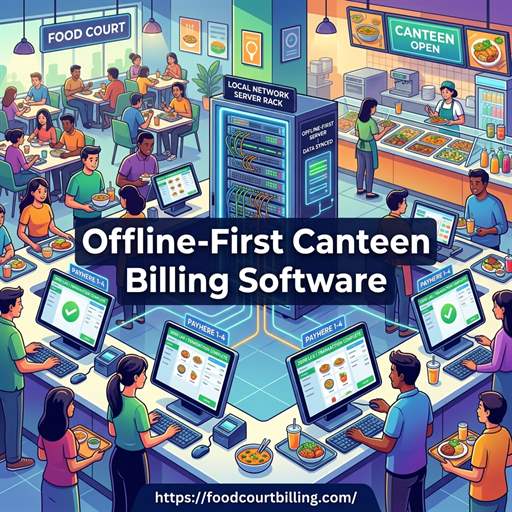
An offline-first canteen management system flips the traditional cloud dependency. The primary operational database lives on a high-speed local network server inside the physical facility. POS terminals, thermal printers, and RFID smart card readers communicate directly across a secure Local Area Network (LAN). Transactions execute instantly at hardware-level speeds:
- Local Balance Verification: When an RFID card is tapped, the local server queries its on-premise database and confirms available funds in under 0.5 seconds.
- Instant Kitchen Routing: Thermal KOT printers and Kitchen Display Systems (KDS) receive order details immediately over the local network.
- Asynchronous Background Cloud Sync: The local server stores encrypted transaction logs and syncs them automatically to centralized cloud management consoles whenever internet bandwidth becomes available.
Comparative Analysis: Offline-First Local Server vs. Pure Cloud POS
| Feature Comparison | Offline-First Local Server POS | Pure Cloud-Based POS |
|---|---|---|
| Transaction Speed | Sub-second (0.3 to 0.5s per tap) | 3 to 12 seconds per transaction |
| Internet Outage Impact | Zero downtime (100% operational) | Complete terminal shutdown |
| Network Dependency | Runs entirely over local LAN | Requires continuous broadband connection |
| Kitchen Order Printing | Instant local KOT dispatch | Delayed during internet latency spikes |
| Data Security | On-premise encrypted local database | Subject to public internet interception |
Eliminating Revenue Loss from Abandoned Lines
In high-pressure dining environments, long queues directly correlate with lost revenue. When diners see sluggish lines caused by freezing cloud registers, they frequently abandon their purchase or skip meals entirely. By cutting transaction time down to a single card tap on an offline local server, canteen operators can double cashier throughput, capturing 100% of potential food sales during compressed lunch breaks.
Rugged Hardware Built for Kitchen Heat & Steam
Offline-first systems run on rugged industrial touch terminals designed specifically for greasy, steamy food service environments. Paired with high-speed thermal receipt printers and waterproof desktop RFID card reader/writers, the hardware handles thousands of taps daily without hardware fatigue or overheating.
Deploy Offline-First Canteen Billing
Advance Technology Systems (ATS) provides battle-tested offline-first canteen billing software, local server networks, prepaid RFID cards, and multi-counter POS systems.
Conclusion
While cloud technology has its place for remote executive reporting, relying on cloud-dependent POS systems during peak dining rush hours is a major operational risk. Implementing offline-first canteen billing software guarantees zero internet downtime, sub-second transaction speeds, and complete operational peace of mind.
FAQs: Offline-First Canteen Billing Software
- Q1: What is offline-first canteen billing software?
- A: Offline-first canteen billing software is a point-of-sale architecture where transaction verification, smart card balance reads, and order printing are executed on an on-premise local server without requiring an active internet connection.
- Q2: Why do cloud POS systems fail during peak canteen lunch hours?
- A: During peak hours, hundreds of transactions happen every minute. Cloud POS systems rely on continuous internet connectivity. High latency, broadband drops, or cloud server timeouts cause the registers to freeze, halting food delivery.
- Q3: How fast are transactions on an offline-first canteen POS?
- A: Because all operations run over the local area network (LAN), an RFID smart card payment validates in under 0.5 seconds, compared to 5 to 15 seconds for cloud payment gateways.
- Q4: How does offline software sync transaction records with management dashboards?
- A: The local server queues encrypted transaction logs and automatically syncs them to the cloud database in the background whenever internet connectivity is restored.
- Q5: Can an offline POS system prevent card balance tampering?
- A: Yes. The system utilizes cryptographic verification between the local server database and the physical RFID chip, ensuring balances cannot be altered offline.
- Q6: Does offline software support Kitchen Order Ticket (KOT) printing?
- A: Yes. LAN-connected thermal printers and kitchen display screens receive orders instantly over the local network without internet reliance.
- Q7: Is an offline local server difficult to maintain?
- A: No. Modern hybrid setups run on compact, solid-state local micro-servers that require minimal maintenance, boot up automatically, and execute automated local database backups.
- Q8: What types of venues benefit most from offline-first canteen software?
- A: High-density canteens such as school cafeterias, corporate office dining halls, manufacturing plant mess facilities, and outdoor event food courts benefit most.
Offline-First Canteen Billing Architecture
Upgrade your dining operations with our offline-first prepaid card software for uninterrupted transaction speeds.