Offline POS Architecture for High-Volume Food Courts: How to Maintain 100% Uptime During Internet Outages
November 19, 2026 in Blog
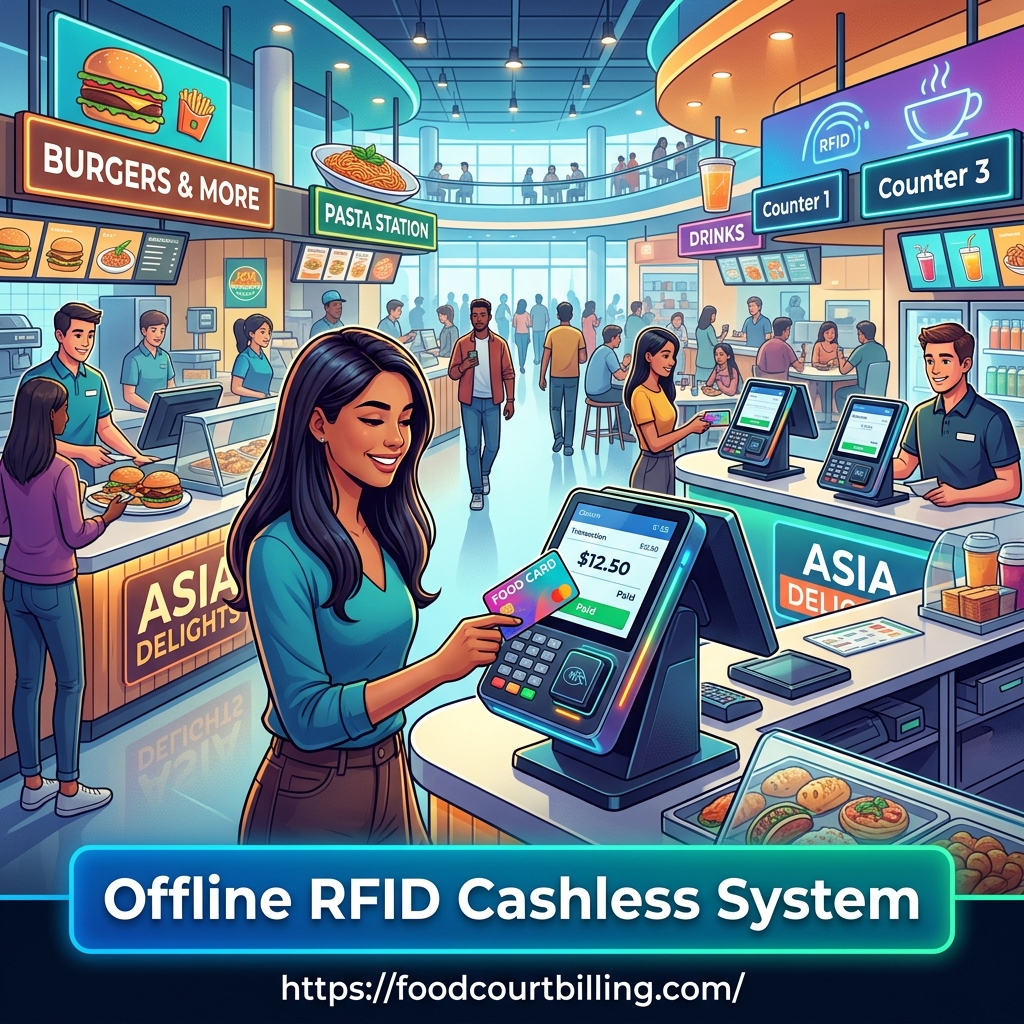
In commercial shopping mall dining halls, airport food plazas, and corporate dining facilities, system availability is non-negotiable. During peak lunch and dinner rush hours, an active food court processes thousands of dining transactions in rapid succession. If the billing infrastructure relies entirely on remote cloud servers and the facility's commercial broadband link suffers an ISP fiber cut, hardware router crash, or severe network latency, operations grind to an immediate, catastrophic halt. Implementing an offline food court POS and smart prepaid card billing system engineered around a local-first, distributed architecture guarantees 100% uninterrupted business continuity regardless of external network disruptions.
The High Financial Cost of POS Downtime in Dining Facilities
When an internet outage strikes a cloud-dependent dining facility, the consequences are immediate and severe. Cashiers cannot open tables, customers cannot pay with digital cards, lines back up into retail corridors, and patrons walk away in frustration. In commercial real estate, food court tenants and mall landlords cannot afford a single minute of downtime during peak trading windows. Relying solely on third-party cloud infrastructure creates a precarious single point of failure that threatens revenue assurance.
A resilient dining facility mandates a local-first operational paradigm where every critical business transaction executes on-premise with microsecond responsiveness, completely insulated from the vulnerabilities of the public internet.
Local-First Distributed Architecture vs. Cloud-Only Vulnerabilities
Most generic point-of-sale applications were built as basic browser-based web applications that execute REST API requests across public telecommunications networks for every action. When network lag spikes, the cashier interface freezes, leading to agonizing delays at the checkout counter.
In contrast, an enterprise offline food court architecture utilizes an on-premise edge computing server:
- On-Premise Relational Database: Core menu structures, pricing tables, tenant tax codes, and user permissions reside within an encrypted local database (such as SQLite or local SQL server) installed on a ruggedized in-house controller.
- High-Speed Local Area Network (LAN): Cash desks, tenant counters, self-ordering kiosks, and kitchen displays communicate over dedicated, hardwired Gigabit Ethernet or private 5GHz Wi-Fi access points.
- Sub-300 Millisecond Transactions: Card balance lookups, item debits, and receipt print commands complete over the private LAN in less than 300 milliseconds—exponentially faster than any remote web call.
Closed-Loop RFID Cryptography in Zero-Connectivity Environments
The pinnacle of offline resilience is achieved through closed-loop contactless RFID smart cards. High-frequency 13.56 MHz smart chips (such as MIFARE Classic or MIFARE DESFire) store encrypted wallet balances and security sectors directly on the physical card. When a customer taps their card at a food counter:
- The terminal reader performs mutual cryptographic authentication using hardware-secured SAM (Secure Access Module) chips.
- The current encrypted card balance is read, validated against the local server ledger, and debited instantly.
- The newly updated balance is written directly back to the physical card chip while logging the transactional delta to the local encrypted journal.
This closed-loop exchange takes less than 0.3 seconds and operates with complete autonomy even if all external internet lines are severed.
Asynchronous Delta Synchronization and Cloud Telemetry
A crucial engineering component of offline architecture is multi-master data replication. Rather than attempting to dump large database files that choke narrow broadband connections, the on-premise server utilizes an asynchronous event queue. All offline transactions, top-ups, and refunds are logged with unique cryptographic monotonic sequence numbers. As soon as the system verifies a stable internet connection, lightweight JSON micro-batches push queued records to the corporate cloud dashboard, ensuring management enjoys unified enterprise telemetry without ever compromising local operational uptime.
Protect Your Food Court Against Internet Outages
Advance Technology Systems (ATS) specializes in offline-first, local-server POS billing systems that ensure 100% uninterrupted operations in malls, food courts, and cafeterias.
Conclusion
Adopting advanced digital POS and cashless payment architectures is essential for modern high-volume dining, educational campuses, and live event operations. By automating transactions, streamlining kitchen workflows, and eliminating cash shrinkage, operators secure maximum operational efficiency and deliver superior customer satisfaction.
FAQs: Offline POS Architecture for High-Volume Food Courts: How to Maintain 100% Uptime During Internet Outages
- Q1: What is an offline-first POS architecture for food courts?
- A: An offline-first POS architecture is a localized system design where all billing transactions, menu searches, RFID card debits, and kitchen order routing execute on an on-premise local server without depending on an active internet connection.
- Q2: How do prepaid RFID cards process payments when the internet is completely down?
- A: Closed-loop RFID smart cards store encrypted balance information and sector keys directly on the card chip (or on the local on-premise LAN server), enabling readers to authenticate and deduct funds in under 0.3 seconds offline.
- Q3: How does data synchronize to the corporate cloud once connectivity resumes?
- A: The local POS server runs a background delta-synchronization daemon that queues all completed offline transactions and pushes them incrementally to the central cloud database as soon as the broadband connection stabilizes.
- Q4: Can multi-counter food courts communicate with each other while offline?
- A: Yes. All cash desks, tenant counters, kiosks, and kitchen display systems connect via a local private Ethernet/Wi-Fi Local Area Network (LAN), allowing full inter-device communication without external internet.
- Q5: What happens if a customer tops up a card at Counter A and spends at Counter B offline?
- A: In an on-premise local server configuration, Counter A and Counter B both query the local in-house database over LAN in real time, reflecting the newly added funds immediately across all stalls without requiring internet access.
- Q6: How does offline POS architecture prevent double spending and fraud?
- A: Cryptographic security keys, local transaction sequencing, and chip-level tamper validation prevent cloned cards, unauthorized balance tampering, or double spending across counters.
- Q7: Why do cloud-only POS systems fail during peak food court rushes?
- A: Cloud-only systems require round-trip API requests over public broadband for every single keystroke, card tap, and receipt print. Network latency, packet drops, or ISP outages immediately lock cash drawers and halt lines.
- Q8: Can offline food court systems generate printed tax receipts and KOTs without internet?
- A: Yes. Thermal receipt printers and kitchen order printers connect directly to local POS terminals via USB, RS-232 serial, or local network IP addresses, operating seamlessly regardless of internet status.
Offline POS Architecture for High-Volume Food Courts: How to Maintain 100% Uptime During Internet Outages
Discover how local-first offline POS architecture keeps multi-counter food courts operating seamlessly without internet, preventing costly dining hall downtime.